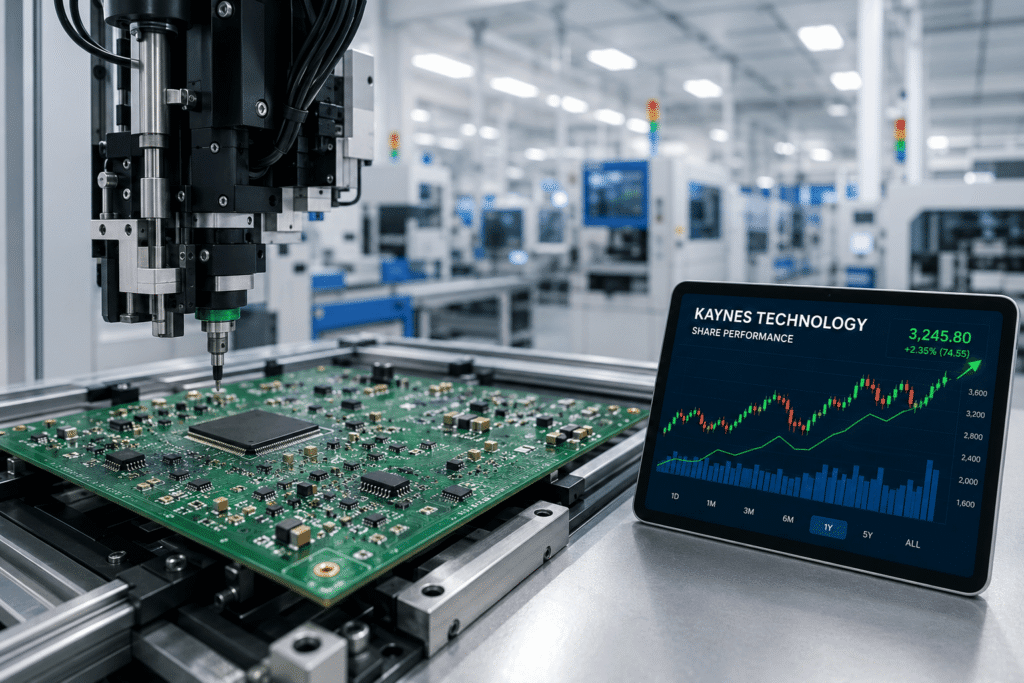
Kaynes Technology India has become one of the more talked-about names in India’s electronics manufacturing space since its stock market debut in late 2022. For anyone tracking India’s growing electronics and semiconductor ecosystem, the kaynes technology share has turned into a case study of how quickly a company’s market value can rise, and how sharply it can correct once growth expectations meet real-world execution challenges. This article walks through the company’s business, its financial journey, and what currently shapes investor sentiment around the stock.
Thank you for reading this post, don't forget to subscribe!What Kaynes Technology Actually Does
Kaynes Technology was incorporated in 2008 and has grown into an end-to-end electronics manufacturing services company. It doesn’t just assemble circuit boards; it offers conceptual design, process engineering, integrated manufacturing, and life-cycle support to clients across a wide range of industries. These include automotive, industrial equipment, aerospace and defence, outer space, nuclear, medical devices, railways, and Internet of Things applications.
This breadth matters because it reduces the company’s dependence on any single sector. A slowdown in, say, consumer electronics doesn’t necessarily hurt Kaynes the way it might hurt a company that only serves that one industry. The company operates through more than a dozen advanced manufacturing plants and has steadily expanded its capabilities from basic assembly work toward higher-value segments like printed circuit board manufacturing and semiconductor packaging.
The IPO and Early Stock Market Journey
Kaynes made its market debut on November 22, 2022, with an issue price of Rs 587 per share. What followed was one of the more dramatic wealth-creation stories on Indian exchanges in recent years. Within about two years, the kaynes technology share had risen roughly tenfold, touching record highs above Rs 5,800 by October 2024, driven largely by optimism around India’s electronics manufacturing push and the company’s entry into semiconductor assembly and testing.
A major catalyst during this period was the government’s approval of a proposal from Kaynes Semicon, the company’s wholly-owned subsidiary, to set up a semiconductor unit in Sanand, Gujarat. This move positioned Kaynes as one of the early Indian players attempting to build domestic capacity in outsourced semiconductor assembly and test, commonly referred to as OSAT, a segment the Indian government has been actively incentivizing.
Financial Performance That Fueled the Rally
The stock’s rise wasn’t purely sentiment-driven. It was backed by genuine earnings growth. In the fourth quarter of financial year 2025, Kaynes reported strong results with profit zooming 43 per cent year-on-year to ₹116.2 crore, compared to the same period a year earlier. Revenue surged 54 per cent annually to ₹984.5 crore during that quarter.
At the operating level, the numbers were even more encouraging. EBITDA jumped 76 per cent year-on-year, with margins expanding by over 200 basis points to above 17 per cent. Management pointed to a healthy order book exceeding Rs 6,500 crore as of March 2025, which gave the company reasonable revenue visibility heading into the following fiscal year.
This kind of consistent, high double-digit growth is exactly what justifies premium valuations in growth stocks, and it’s a big part of why the kaynes technology share commanded such rich multiples during 2024 and much of 2025.
The Correction Phase
Markets rarely move in a straight line, and Kaynes has been no exception. After peaking near record highs, the stock entered a prolonged correction. By mid-2026, the kaynes technology share was trading in the range of Rs 3,200 to Rs 3,300, a steep decline from its 52-week highs, which at various points touched levels well above Rs 5,000 and even higher earlier in its trading history.
Several factors contributed to this pullback. Broader market pressure from global trade tensions, including tariff-related uncertainty affecting Indian exporters, created outflows from foreign institutional investors across many mid- and small-cap names, not just Kaynes. Profit-booking after such a sharp multi-year rally was also natural, since valuations had stretched to levels that priced in near-perfect execution for years to come.
Company-specific concerns also played a role. Some reports pointed to working capital pressures, execution delays on certain projects, and a moderation in profit growth compared to the blistering pace seen in earlier quarters. For a stock that had been valued on the assumption of flawless, uninterrupted expansion, even modest disappointments were enough to trigger sharp de-rating.
Understanding the Valuation Picture
One thing that becomes clear when studying the kaynes technology share is just how much growth expectation gets baked into the price. At various points, the stock traded at price-to-earnings ratios well above 100, and even after the correction, valuations remain elevated compared to many industrial peers. This isn’t necessarily a red flag on its own, since fast-growing companies in emerging sectors often command such premiums, but it does mean the stock carries higher risk if growth slows even temporarily.
Investors evaluating the kaynes technology share today need to weigh this valuation context carefully. A company trading at 40, 50, or 60 times earnings needs to keep delivering strong double-digit growth quarter after quarter to justify that price tag. Any hint of a miss, whether in revenue, margins, or order inflows, tends to get punished more severely than it would for a lower-multiple stock.
Why the Stock Keeps Attracting Attention
Despite the volatility, interest in the kaynes technology share hasn’t faded. India’s push toward electronics manufacturing self-reliance, backed by production-linked incentive schemes and semiconductor mission funding, continues to create tailwinds for companies like Kaynes. The global trend of diversifying supply chains away from a single-country concentration has also opened doors for Indian electronics manufacturing services players to win business that might previously have gone elsewhere.
Kaynes’s expansion into semiconductor assembly, testing, and bare PCB manufacturing represents a strategic bet on capturing more value within the electronics supply chain rather than remaining purely an assembly player. If these newer segments scale successfully, they could meaningfully change the company’s margin profile and growth trajectory over the coming years.
Risks Worth Watching
No discussion of the kaynes technology share would be complete without acknowledging the risks. Competition is intensifying, both from established domestic electronics manufacturing services companies and from new entrants attracted by government incentives in the sector. This could pressure pricing power over time.
Currency fluctuations and commodity price swings also introduce quarterly earnings volatility, since the company sources components and materials that are subject to global price movements. Its ability to pass these costs through to customers directly affects margins.
Execution risk is another factor. Setting up new semiconductor and PCB manufacturing capacity is capital intensive and operationally complex. Delays in ramping up these facilities, or slower-than-expected order conversion, could weigh on both revenue growth and investor sentiment.
Finally, the stock’s history shows it can be highly sensitive to broader market conditions. Global trade policy shifts, interest rate movements, and foreign investor flows into Indian equities all tend to have an outsized impact on high-growth, high-valuation names like this one.
What Long-Term Investors Should Consider
For investors thinking about the kaynes technology share as a long-term holding rather than a short-term trade, the key question isn’t where the price sits today but whether the underlying business can keep growing into its valuation. The company operates in structurally favorable sectors: electronics manufacturing, semiconductor assembly, and industrial and defense electronics, all of which have strong policy support in India right now.
That said, the sharp swings this stock has already experienced, from a tenfold rise to a substantial correction within a few years, are a reminder that high-growth stocks in emerging sectors rarely move smoothly. Position sizing, a clear understanding of one’s own risk tolerance, and patience through volatile periods matter more here than trying to perfectly time entry or exit points.
Final Thoughts
The kaynes technology share represents one of the more compelling growth stories to emerge from India’s electronics manufacturing boom, but it’s also a stock that demonstrates how quickly sentiment can shift when valuations run ahead of fundamentals. The company’s core business remains solid, backed by a diversified client base, an expanding manufacturing footprint, and a credible push into higher-value semiconductor and PCB segments.
At the same time, investors need to stay grounded in the reality that premium valuations demand consistent delivery, and any slippage tends to get amplified in the share price. Anyone considering an investment should look beyond the headline price movements and dig into quarterly execution, order book trends, and margin trajectory before forming a view on where this stock heads next. As always, individual research and consultation with a qualified financial advisor should guide any actual investment decision.
FAQs on Kaynes Technology Share
What does Kaynes Technology do?
Kaynes Technology is an Indian electronics manufacturing services company. It handles everything from product design to full-scale manufacturing for clients in automotive, defence, aerospace, medical, railways, and IoT sectors.
When did Kaynes Technology get listed on the stock market?
The company made its debut on the Indian stock exchanges on November 22, 2022, with an issue price of Rs 587 per share.
Why has the kaynes technology share been so volatile?
The stock rose nearly tenfold within two years on strong earnings growth and optimism around India’s electronics and semiconductor push. It later corrected sharply due to profit booking, elevated valuations, global trade tensions, and some execution-related concerns.
Is Kaynes Technology involved in semiconductor manufacturing?
Yes. Through its subsidiary Kaynes Semicon, the company is setting up a semiconductor assembly and testing unit in Sanand, Gujarat, as part of India’s broader semiconductor mission.
Is the kaynes technology share a good long-term investment?
That depends on individual risk appetite. The company operates in a structurally growing sector with strong policy support, but it also trades at premium valuations, which makes it sensitive to any slowdown in growth. Investors should evaluate quarterly performance, order book trends, and valuation levels before deciding, and ideally consult a financial advisor.
What risks should investors keep in mind?
Key risks include rising competition in the electronics manufacturing space, currency and commodity price fluctuations, execution delays in new manufacturing facilities, and broader market sensitivity affecting high-valuation growth stocks.
Does Kaynes Technology pay dividends?
As of the latest available data, the company has not been paying out dividends, choosing instead to reinvest profits into expanding its manufacturing and semiconductor capabilities.